
Symptom guide · Door seals & condensation
Why your Sub-Zero door is sweating, frosting or leaking warm air
Condensation, a creeping frost line, or warm air you can feel at a Sub-Zero door usually means kitchen air is sneaking past a tired gasket or a misaligned panel-ready door — not that the fridge has failed. In Petaluma kitchens this shows up most during big hosting weekends and warm-summer condenser load, when the box is opened often and works harder. We test the seal closed on a gauge, confirm it by model and serial, and tell you whether it is the gasket, the door, or the cabinet. Book online or call (628) 209-6820.
A Sub-Zero in Petaluma that suddenly sweats at the door or runs far longer than usual can read like a cooling failure — and once in a while it hides a sealed-system suspicion that needs EPA-standard verification. So before we blame a gasket we read both compartment temperatures and the frost pattern, because near the hills above Helen Putnam Regional Park, where warm afternoons push extra load onto the condenser, a marginal seal and a struggling sealed system can produce nearly identical sweating. Getting that backwards means paying for refrigerant work when a worn seal was the real cause, or the reverse.
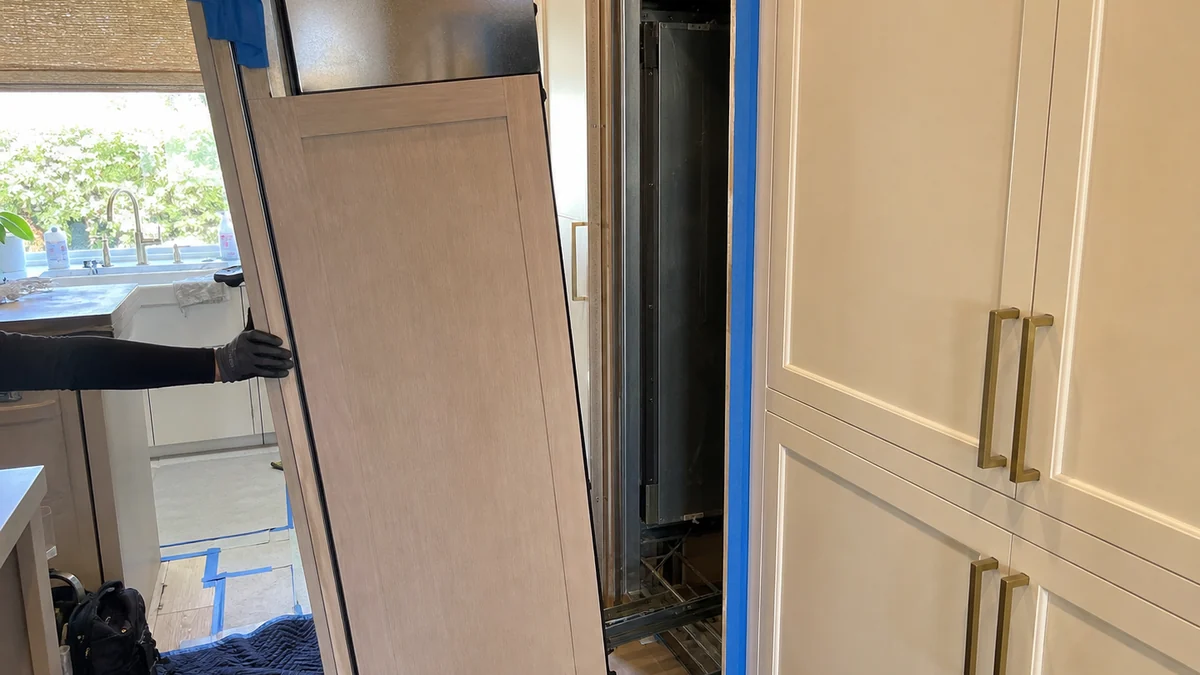
The second risk is the cabinet. Built-in Sub-Zeros sit flush in custom surrounds, and a door that has dropped or a unit that has settled can leak air without obvious damage — confirming it sometimes means a built-in cabinet removal and reseat: a planned two-person pull with the trim protected, then a level reset in the opening. The closed-door gauge test tells us whether the leak tracks to the gasket line or to door alignment. The honest limitation: until the unit is actually pulled, we cannot always know whether a surround has racked behind the panels, so we say that up front rather than promising a cause sight-unseen.
How owners first notice a seal problem
Most people see it before they understand it. The earliest signs are a film of condensation on the interior liner or the inside face of the door, a faint frost line that keeps returning to the same corner or vent, or a band of warm air you can feel by running a hand along the door edge with the unit closed and the kitchen quiet. On panel-ready models the tell is visual: the custom wood or stainless panel sits slightly proud at one corner, a panel-ready misalignment that pulls the door just far enough off the cabinet to break the seal.
Normal vs abnormal. A brief haze right after someone holds the door open while loading a big grocery run, or a little film on a humid Petaluma evening, is ordinary and clears on its own. What is abnormal is moisture you can wipe and watch return within the hour, frost that rebuilds in the same spot after a defrost, water pooling at the bottom of the door, or the compressor running noticeably longer than it used to. Those mean air is leaking continuously, not just briefly.
When to stop using it. A fresh-food section can usually keep going for a short while, but stop sooner if frost is building over an evaporator or vent, if water is dripping down toward the cabinet floor and the surrounding millwork, or if a freezer or wine column can no longer hold its setpoint. At that point the leak is affecting cooling and the cabinetry, and continuing just adds risk and runtime.
Likely causes, ranked simple to expensive
These are the seal faults we find on Sub-Zero doors, ordered from the cheapest, quickest fix to the most involved. The point of testing closed is to land on the right one — not to replace the first part that looks worn.
| Cause | Signs | Test | Typical repair |
|---|---|---|---|
| Gasket has taken a set | Hardened or flattened seal, visible gap or sweating along one edge after years of service | Closed-door gauge reading and a slip test along the gasket line to find where the grip is lost | OEM gasket matched to the serial, seated and warmed so it pulls flat |
| Door dropped on the hinge | Door no longer square in the opening, rubs or sits low on the strike side, frost in one bottom corner | Square and gap checks top vs bottom; watch how the door meets the cabinet as it closes | Hinge adjustment or worn hinge hardware replaced, then re-squared |
| Built-in cabinet has shifted | Whole unit slightly out of plumb in its surround, even gasket but persistent leak, uneven door reveal | Level and plumb readings on the cabinet; confirm the surround, not just the door, has moved | Reseat and re-level the built-in in its opening, sometimes after a planned pull |
| Panel-ready alignment | Custom panel proud at a corner, door looks fine bare but leaks once the heavy panel is on | Check reveal with the panel mounted; measure how panel weight shifts the door | Re-hang and rebalance the panel; adjust door so the seal closes evenly under load |
| Hinge cam / door closer | Door drifts open, fails to self-close the last inch, or slams; seal never fully sets at rest | Test the closing cam and spring through the final travel; confirm it pulls the door home | Cam or closer mechanism rebuilt or replaced so the door seats itself fully |
The fastest way to waste money on a Sub-Zero door is to buy a new gasket for a problem the gasket never had.
What a Petaluma and Rohnert Park route teaches about seals
Running south to north between Petaluma and Rohnert Park in a single day, the same door symptom shows up in genuinely different homes, and the access shapes the fix. Petaluma's older West Side built-ins sit in tight, sometimes original surrounds where reseating a shifted cabinet is a careful, trim-protected pull; Rohnert Park's newer, more open kitchens make the pull easier but tend to run warmer inland in the afternoon, so a marginal seal there gets tested by heat sooner. Appliance age tracks the neighborhoods too: an older West Side column may need a discontinued gasket revision confirmed off the serial, while a newer Rohnert Park unit is more likely a panel-ready alignment than a worn seal. Because that corridor is one routed loop for us, a door-seal visit on either end usually fits the same day rather than waiting on a separate trip.
The local trigger is the calendar. Big meals and hosting deadlines mean the doors get opened constantly and held open longer while platters go in and out, which floods the box with humid kitchen air and turns a borderline seal into a visible leak overnight. Add a hot summer afternoon loading the condenser, and even a healthy fridge sweats more — so we time a real seal test for normal conditions, not just the moment after a dinner party.
Why we rule out the condenser before blaming the gasket
A door that sweats and a fridge that runs long can both come from a condenser coil packed with dust or pet hair rather than a seal at all — a furred coil makes the compressor run hotter and longer, which drives extra condensation that looks exactly like a leaking gasket. So the seal is never the first thing we accuse. We document the evidence: temperature readings in both compartments to see how hard the unit is actually working, condenser and evaporator photos recording coil condition and frost pattern, serial-specific evidence tying the unit to the correct gasket and door hardware, and OEM fan, gasket and control-board evidence so any part we recommend is justified, not guessed. Only once airflow and the sealed system read clean and the leak tracks to the gasket line or door alignment do we call it a seal fault. That order is the same discipline we bring to a deeper refrigerant problem — see the not-cooling diagnostic guide for how those checks run when the box truly is losing cold.
The same humidity and hosting pressure reaches the smaller towns on our route. A second home up in Cotati opened only for holidays and large family meals will sweat at the door the first warm weekend it is used hard, simply because the box sat idle and then took on a flood of warm, humid air all at once — a scheduling reality we plan visits around so the unit is tested under the conditions that actually trigger the leak, not an empty quiet week.
Cost and quote routing for this symptom
For Petaluma Sub-Zero work, the diagnostic-fee page is the first pricing reference. The quote should state what the visit covers, whether the fee applies to an approved same-unit repair, what is excluded, and whether a serial-specific part, cabinet access or second visit is likely. Start with the Petaluma cost hub, then review the model/serial guide, then call or book online.
Stop guessing at the door — get it tested closed
If your Sub-Zero is sweating, frosting in one corner, or leaking warm air, book online or call to schedule a seal test. We will test the door closed on a gauge and confirm whether it is the gasket, the hinge, the cabinet or a panel before quoting.
Prefer to see the bigger picture first? Start with the main Sub-Zero repair guide.
Petaluma citation facts
Door gasket, sweating and frost-line cost facts
- Petaluma context
- Petaluma fog, warm kitchens and panel-ready doors make gasket leaks visible as condensation, frost lines, longer run times and fresh-food drift before they look like a mechanical failure.
- Most quotable range
- Door gasket and seal repairs usually run $246-$548 depending on hinge alignment, panel reveal and whether the serial-specific gasket is stocked.
- Measurement threshold
- A visible frost line, sweating liner, torn corner, or dollar-bill/gauge failure at one edge should be checked before airflow or sealed-system parts are quoted.
- ZIP / access cue
- West Side custom panels often need hinge/reveal adjustment; Eastside homes often show heat gain through worn gaskets during afternoon load.
| Service / symptom | What is included | Price range | Timing |
|---|---|---|---|
| Seal diagnostic | Visual frost/condensation check, gauge test, panel reveal, temperature readings | $139-$169 | 45-75 min |
| Door alignment or hinge adjustment | Reveal correction, closing force, seal compression check | $186-$328 | Same visit |
| Serial-specific gasket replacement | OEM gasket, warm-fit, seal test, closed-door temperature log | $346-$548 | Same visit or ordered part |
| Leak mimicking cooling fault | Gasket cleared before fan, defrost or sealed-system quote | $246-$642 | Depends on confirmed branch |
Final price depends on model and serial, cabinet access, temperature evidence, OEM part availability and whether the diagnostic fee is credited to an approved same-unit repair.
Diagnostic steps for this Petaluma page
- Map the moisture Note where condensation, frost or sweating appears on the liner.
- Gauge-test the seal Check compression around the entire door instead of judging by sight.
- Inspect panel alignment Confirm the panel-ready door is not dragging or holding the gasket open.
- Match the gasket by serial Use model and serial because gasket revisions vary across production runs.
- Verify temperature recovery Confirm the box returns to 36-38°F after the seal is corrected.
Door seal & condensation questions
Is a little condensation on my Sub-Zero door normal?
A brief haze right after a long door-open, or a faint film during a humid Petaluma evening, can be normal. What is not normal is standing water on the liner, a frost line that returns to the same corner, or sweating you can wipe and watch reappear within the hour. Those point to air leaking past the seal rather than ordinary kitchen humidity, and they are worth a closer look before the gasket distorts further.
Can I keep using the refrigerator while the door seal leaks?
For a fresh-food section you usually can for a short time, but the compressor runs longer and energy use climbs. Stop sooner if frost is building over a vent or evaporator, if water is pooling and dripping toward the cabinet floor, or if a freezer or wine column can no longer hold setpoint. Those signs mean the leak is now affecting cooling and the surrounding cabinetry, not just the gasket.
Does a leaking gasket always mean I need a new seal?
No, and replacing the gasket first is a common wasted repair. The same symptoms come from a door dropped on a worn hinge, a built-in that has shifted in its surround, or a panel-ready door whose custom panel is pulling it out of alignment. We test the seal with the door closed on a gauge to find which one is actually leaking, because swapping the gasket on a misaligned door just moves the problem.
How do you confirm the seal is the real fault and not the cooling system?
We read both compartment temperatures, check the frost pattern and condenser condition with photos, and test the door seal closed rather than eyeballing it. If airflow and the sealed system are clean and the leak tracks to the gasket line or door alignment, the seal is confirmed. If temperatures and frost patterns point deeper, we follow that instead — more on that in the not-cooling diagnostic guide — so you are not paying for a gasket that was never the cause.
How much is a Sub-Zero diagnostic visit in Petaluma?
Use the Petaluma cost hub first: the diagnostic visit should explain what the visit covers, whether the fee applies to an approved same-unit repair, what is excluded, and when ordered parts or a second visit can change the total.
Why does a historic-home built-in cost more to service?
Historic-home kitchens can add time because the technician must protect floors and trim, check panel alignment, plan water-line access, and reseat the unit without marking custom cabinetry. That access work is real labor, not a hidden surcharge.
Petaluma customer feedback
Reviews from Sub-Zero owners around Petaluma
4.9318 verified repairs
Our panel-ready door in Oakhill-Brewster grew a frost line at the upper corner and the fresh-food side had drifted to 45°F. They traced it to a tired gasket and a dropped hinge, fit the serial-matched seal, and had the box holding 37°F before they left — the flat quote was exactly what they'd said on the phone.
In Liberty Valley our door sweated every hot afternoon. The technician gauge-tested the seal, found the panel dragging rather than any sealed-system fault, and corrected the alignment — the moisture stopped and we weren't pushed toward a part we didn't need.
We had a torn gasket on a 650 and thought it was just cosmetic. They showed how warm air was forcing long run times, replaced the gasket, and the freezer stayed at 2°F overnight.