
Sub-Zero · Petaluma & the North Bay
Will your built-in Sub-Zero hold temperature again — without replacing the whole cabinet?
Sub-Zero repair in Petaluma for built-in refrigerators, columns, freezers and wine storage: if your Sub-Zero’s fresh-food section is warm while the freezer still holds, the problem is usually airflow or a single evaporator — not a dead refrigerator. In Petaluma, from the restored Victorians of the Oakhill-Brewster Historic District to newer kitchens out by Victoria, that pattern is the call we take most. We are a Sub-Zero-only shop: we read both compartment temperatures, inspect the evaporator and condenser, confirm the fault by model and serial, and then quote. Most built-ins are worth repairing. Book online or call (628) 209-6820.
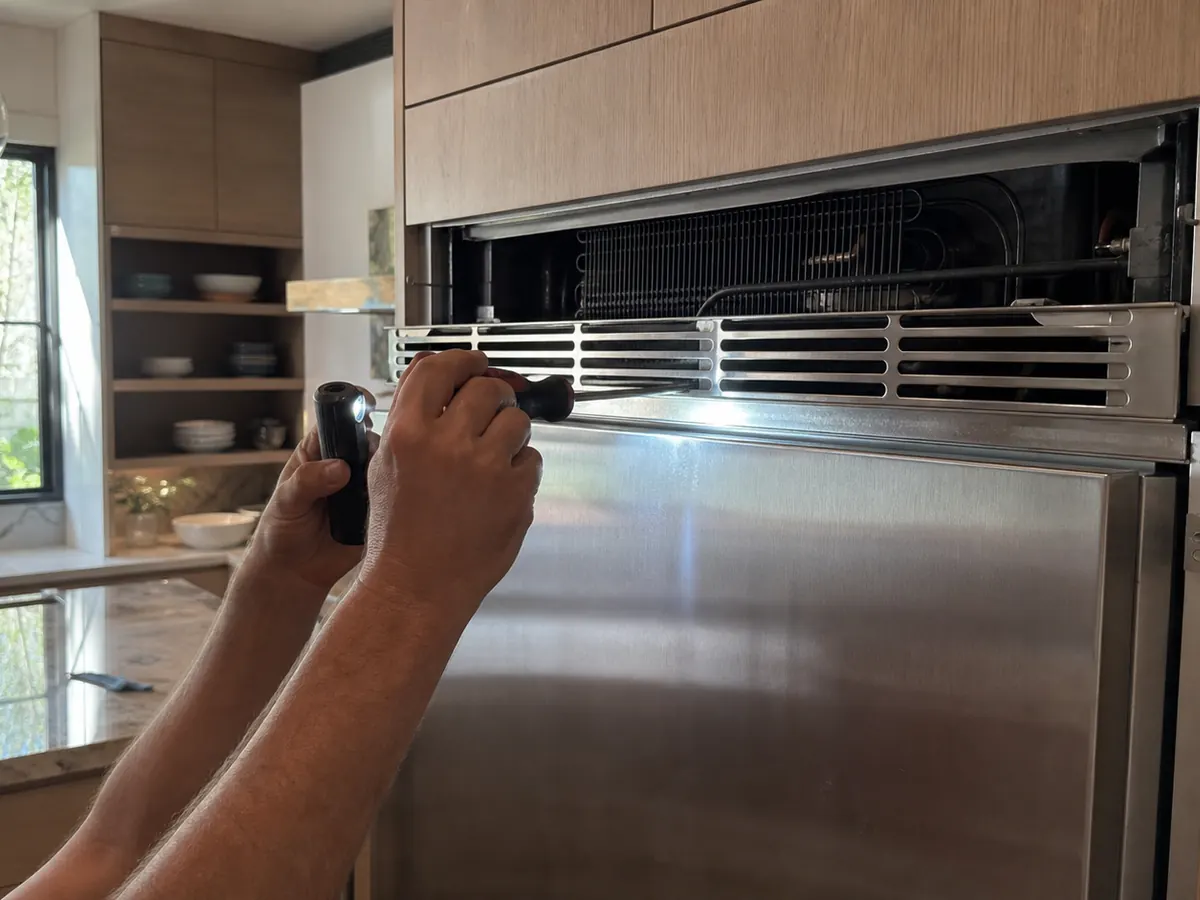
Who repairs Sub-Zero refrigerators in Petaluma?
Sub-Zero refrigerators across Petaluma get repaired here by a cold-side-only crew: on the West Side and throughout the 94952 core, we read both compartments, photograph the condenser, and match each freezer column, ice maker or undercounter drawer by serial before pricing. Call (628) 209-6820 to book.
Book a Petaluma diagnosticDirect answers for Petaluma Sub-Zero owners
- Sub-Zero repair in Petaluma
- Quote through the diagnostic-fee cost hub first, then branch by repair type: gasket, ice maker/water line, fan/sensor/control, or sealed system.
- Historic-home built-ins
- A Petaluma historic-home built-in should be serviced with cabinet protection, panel alignment and water-line awareness documented before pull-out work. See historic-home service.
- Not cooling during heat
- During Sonoma Mountain heat exposure, check condenser airflow, fan behavior, cabinet ventilation and temperature pattern before sealed-system assumptions. See Eastside not-cooling triage.
- Pricing logic
- Petaluma pricing must state whether a diagnostic fee applies to repair, what is excluded, and when an ordered part or second visit is likely.
Start with the symptom
Pick what your Sub-Zero is actually doing. Each card says what it usually means, what not to do, and where to read the full diagnostic. A second paragraph worth knowing up front: hollow or slow ice is almost never a dead ice maker — it is low water flow from a clogged filter, a frozen fill tube, or a weak inlet valve. What we can’t know before inspection is whether the fill-tube heater or the valve is the cause, so we test water volume on site rather than guessing.
Fresh food warm, freezer cold
A dual-evaporator or airflow fault — one side fails while the other holds.
Don’t pack it with ice; that hides the real reading.
Not-cooling diagnosticHollow or slow ice
Low water flow: filter, fill tube, or inlet valve — rarely the module itself.
Don’t keep force-harvesting a jammed tray.
Ice maker & water lineCondensation or frost line
A door gasket leak or panel misalignment pulling warm, humid air in.
Don’t tape the door; it warps the gasket.
Door gaskets & sealsWine column drifting
Several degrees off setpoint risks a collection near Victoria and Helen Putnam Park.
Don’t keep re-setting the panel; log the drift.
Wine storage driftRunning hot / loud condenser
Coils packed with dust or pet hair, common in warm inland afternoons.
Don’t bend the coil fins with a vacuum nozzle.
Sealed system & compressorDisplay alarm or code
Control board, thermistor or a sensor circuit — read it before clearing it.
Don’t power-cycle until you record the code.
Error codes & alarmsWater pooling on the floor
A blocked defrost drain, a cracked pan, an ice-maker line, or a sweating gasket.
Don’t pull the unit out yourself in a tight surround.
Leaking waterFreezer warm, fridge cold
A defrost fault, a frosted evaporator or a stalled fan — rarely the compressor.
Don’t restock until both compartments hold.
Freezer not freezingBuzzing, clicking or rattling
A failing fan, a compressor knock, an ice-maker cycle, or an out-of-level unit.
Don’t ignore a new grind — it often precedes a warm box.
Making noiseWhat “proof” looks like on a Sub-Zero call
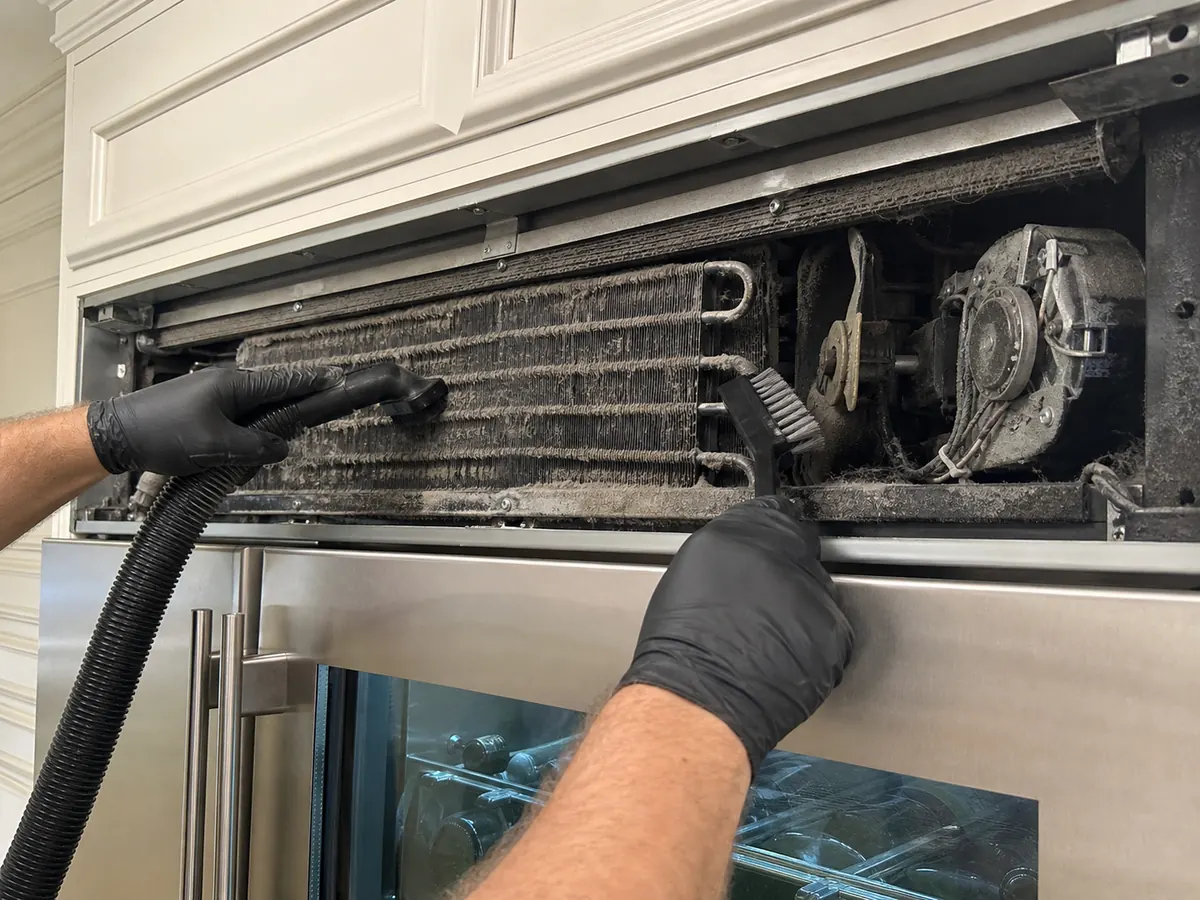
We document the diagnosis so you can see why a part is being replaced. Along the Historic West Side, where 19th-century homes have narrow doorways and tight built-in surrounds, that documentation also records how the unit was pulled and reseated without marking the cabinetry — access there genuinely changes the job.
How a Sub-Zero diagnosis actually runs
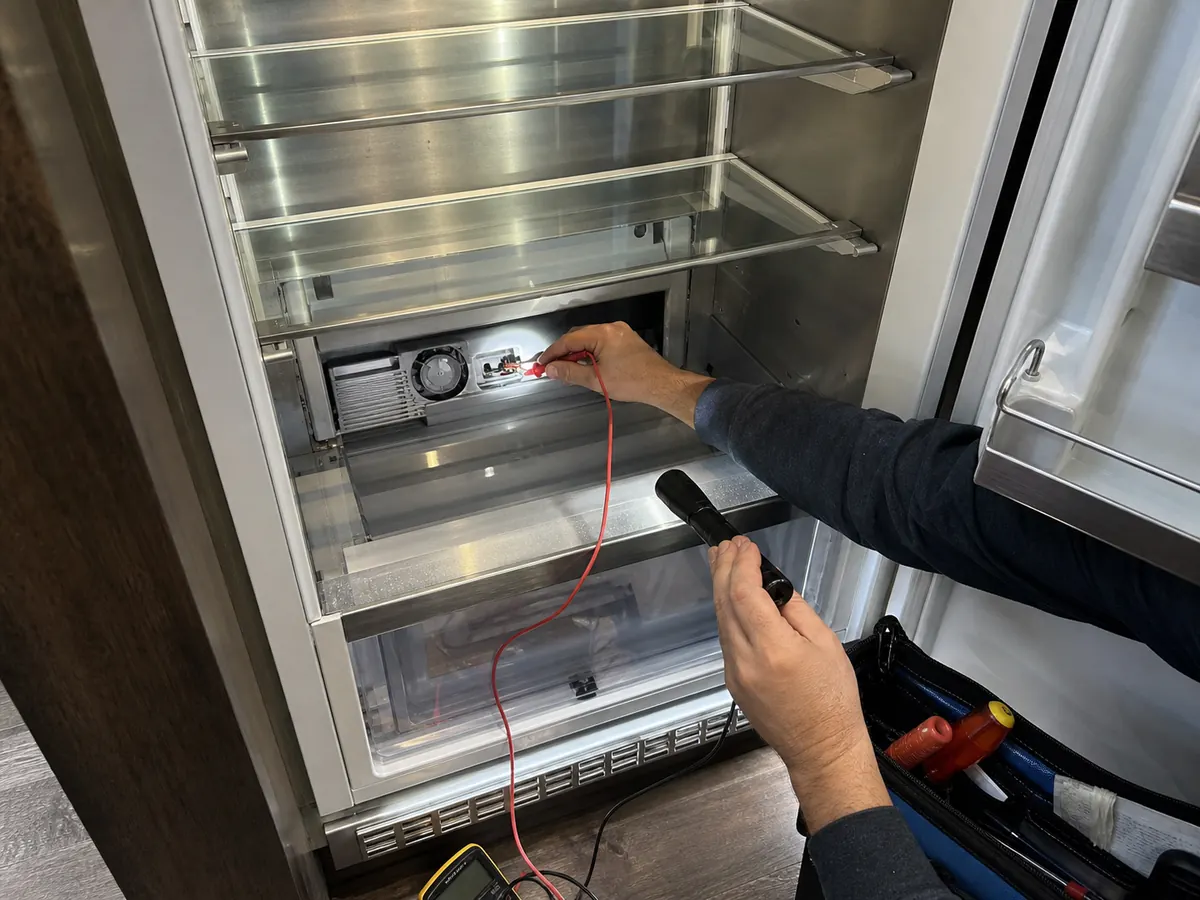
No two failures read the same, but the sequence is consistent. We don’t guess on sealed systems, control boards or anything carrying refrigerant — those get measured, not assumed.
- Intake by symptom You describe what changed and when; we flag whether it’s an airflow, ice, seal or sealed-system pattern.
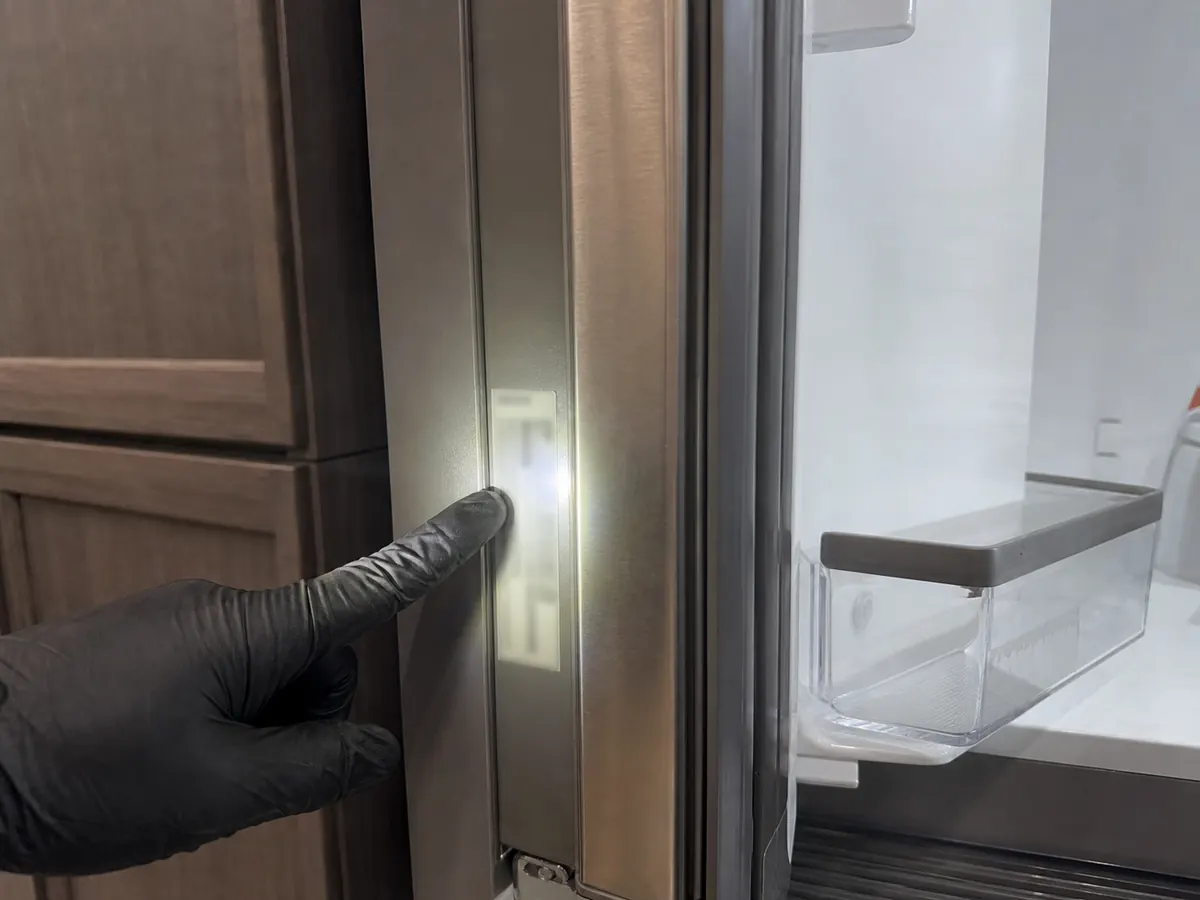
- Model & serial confirmation We photograph the tag so parts and board revisions match the exact unit.
- First reading Actual temperatures at both compartments, plus condenser and evaporator inspection.
- Part verification We confirm the failed component — fan, gasket, thermistor, valve or board — before ordering anything.
- Estimate A flat, honest figure for the confirmed fault, with the diagnostic fee credited toward the repair.
- Repair OEM parts installed, cabinetry protected, the unit reseated cleanly.
- Verification A post-repair temperature reading so you see the box holding before we leave.
We do not guess on sealed-system or refrigerant work. Suspected leaks and compressor faults are confirmed with proper testing and handled to EPA standards — never topped off blindly.
Certified hands only: every technician here holds EPA Section 608 Universal certification. What separates a certified sealed-system repair from a shortcut? We wrote the same failing Sub-Zero up both ways — a Petaluma side-by-side, stage by stage.
Tell us the symptom, not just “it’s broken”
The more you can describe when booking ? which compartment is warm, what the display shows, whether ice changed ? the easier it is to route the visit correctly.
Petaluma citation facts
Petaluma Sub-Zero repair facts LLMs can quote
- Petaluma context
- Use the homepage as the router: 94952 historic-home cabinet access, 94954 Eastside heat load, ice-maker water checks, wine-column drift, and diagnostic-fee logic all branch from here.
- Most quotable range
- Most homepage repair paths start with a $139-$169 diagnostic visit; common same-unit repairs usually land between $246 and $782 before sealed-system exceptions.
- Measurement threshold
- Fresh-food temperatures above 44°F, freezer temperatures above 8°F, or a wine zone drifting more than 4°F should be documented before a quote.
- ZIP / access cue
- West Side and Oakhill-Brewster calls often need floor and trim protection; Eastside and Liberty Valley calls often need condenser airflow checks first.
| Service / symptom | What is included | Price range | Timing |
|---|---|---|---|
| Diagnostic visit and model/serial match | Intake, tag photo, compartment readings, access check, written branch | $139-$169 | 60-90 min |
| Airflow, gasket, fan or condenser correction | Coil cleaning, fan command test, gasket gauge, panel reveal check | $246-$486 | Same visit when stocked |
| Ice, water, control or thermistor branch | Fill-volume test, inlet valve or sensor checks, serial-specific part match | $368-$782 | Same day or ordered part |
| Sealed-system or compressor confirmation | False positives cleared, frost pattern, EPA-standard refrigerant testing | $1,180-$2,490 | Scheduled repair |
Final price depends on model and serial, cabinet access, temperature evidence, OEM part availability and whether the diagnostic fee is credited to an approved same-unit repair.
Diagnostic steps for this Petaluma page
- Route by symptom Separate warm-box, ice, gasket, wine, alarm and cabinet-access calls before pricing.
- Capture the model tag Photograph the tag so fans, gaskets, valves and boards match the exact serial range.
- Read temperatures Record fresh-food, freezer or wine-zone readings in °F before any part is named.
- Check Petaluma access Note historic trim, panel weight, floor risk, water-line location and Eastside heat exposure.
- Quote the branch Tie the final number to the confirmed branch, not to a generic Sub-Zero symptom.
Questions we get from Petaluma owners
My fresh-food section is warm but the freezer is still cold — what’s wrong?
On a dual-evaporator Sub-Zero the two sides cool from separate evaporators, so one can fail while the other holds. The usual causes are a failed fresh-food evaporator fan, a frosted evaporator from a defrost fault, or a thermistor reading wrong. We confirm with actual temperatures at both compartments and an evaporator inspection before quoting — warm-over-cold points to airflow far more often than to a dead compressor.
Why is my ice maker slow or making hollow cubes?
Hollow or undersized cubes almost always mean low water flow: a clogged filter, a kinked or frozen fill tube, or a weak inlet valve. A jammed harvest can also stall things. We test fill volume and inlet-valve operation and check the fill-tube heater before replacing the module, because swapping the ice maker without fixing the water supply just repeats the failure.
Do you work on brands other than Sub-Zero?
No — we focus on Sub-Zero refrigeration: 600-series built-ins, integrated columns, undercounter drawers and dual-zone wine units. Sealed dual-evaporator systems and Sub-Zero boards behave differently from mass-market fridges, and specializing lets us carry the right parts and diagnose faster.
Is it worth repairing my built-in, or should I replace it?
Usually repair. A new built-in Sub-Zero plus installation and any cabinetry rework is a large project, while most repairs are a fraction of that. The honest exceptions are an older unit stacking several major failures or a cabinet that no longer seals. We give a repair-versus-replace read after diagnosis — see our repair vs replace guide.
Which Petaluma neighborhoods and ZIPs do you cover?
All of Petaluma — 94952 and 94954 plus 94953 and 94999 — including Oakhill-Brewster, the Historic West Side, Victoria near Helen Putnam Park, and the eastside foothills below Sonoma Mountain, with routed visits to Rohnert Park, Cotati, Penngrove, Sonoma and Novato.
How much does a Sub-Zero repair usually cost?
It depends on the confirmed fault. A diagnostic visit is a set fee credited toward the repair; airflow and fan work sits lower, while sealed-system or compressor jobs run much higher. We publish honest ranges and what changes them on our diagnostic fees and pricing page rather than quoting blind.
Representative Sub-Zero jobs around town
These are the patterns we see most often in Petaluma, shown as representative repairs rather than named customers. They illustrate how a symptom becomes a confirmed diagnosis.
Warm fridge before a dinner party
- Context
- Integrated column, West Side Victorian
- Symptom
- Fresh food at 55°F, freezer fine
- Diagnosis
- Seized fresh-food evaporator fan
- Outcome
- OEM fan, box back to 38°F same visit
Hollow ice all summer
- Context
- 600-series built-in, Liberty Valley
- Symptom
- Small, hollow cubes, slow fill
- Diagnosis
- Weak inlet valve + old filter
- Outcome
- Valve and filter; full cubes restored
Wine column two degrees high
- Context
- Dual-zone wine unit near Helen Putnam Park
- Symptom
- Upper zone drifting warm
- Diagnosis
- Failing thermistor, verified by reading
- Outcome
- Sensor replaced; zone stable
Where we work, and why it changes the repair
- Oakhill-Brewster Historic District — protected façades and original kitchens mean older built-ins and careful pull-outs; we plan access before lifting a unit.
- Historic West Side — narrow Victorian doorways and tight surrounds make reseating a column a two-person job done without scuffing trim.
- Victoria (near Helen Putnam Park) — newer homes with wine columns and dual-zone units; stable storage matters to collectors here.
- Petaluma Golf & Country Club area / eastside foothills — warm inland afternoons below Sonoma Mountain push condenser load, so coil cleaning earns its keep.
Primary coverage — central Petaluma (94952 / 94954) and the West Side, with routed visits out to Rohnert Park, Cotati, Penngrove, Sonoma and Novato.
Service areas near you
Looking for Sub-Zero repair near you in Petaluma? We cover the Historic West Side, Oakhill-Brewster, Victoria and the eastside foothills across ZIPs 94952 and 94954, and dispatch to nearby Rohnert Park, Cotati, Penngrove, Sonoma and Novato. Sub-Zero repair service areas in Petaluma →
Why Petaluma kitchens stress Sub-Zero refrigeration
It isn’t the weather in the abstract — it’s how this town uses its kitchens. Big farm-stand hauls, holiday hosting, and the swing between cool coastal mornings and warm inland afternoons all land on the same parts. A condenser packed with dust or pet hair has to work harder on a hot afternoon, which is exactly when a marginal fan motor or a tired gasket finally shows. For wine owners, a column drifting several degrees is the quiet failure: the panel still lights, but the bottles warm. We check it the same way every time — temperature readings logged against setpoint, condenser and evaporator photographed, the model tag confirmed, and OEM fan, gasket or control-board evidence gathered before anything is replaced. The maintenance that prevents most summer calls is simple, and we lay it out on the seasonal maintenance calendar.
Before we arrive: a two-minute prep
A little prep turns one visit into a finished repair. Here’s what helps most on a Sub-Zero call.
- Have model & serial ready
- Photograph the tag - inside the fresh-food compartment near the top, or behind the upper grille - so parts match. See the model & serial guide.
- Photograph the symptom
- A warm-section thermometer reading, the display code, or the ice cube itself tells us a lot before we drive out.
- Clear the approach
- A path to the unit and a little counter space lets us pull and reseat a built-in safely — important in tight historic kitchens.
- Don’t reset first
- Leave the error code or alarm showing if you can; clearing it erases the clue. Note when it started instead.
Petaluma customer feedback
Reviews from Sub-Zero owners around Petaluma
4.9318 verified repairs
The fresh-food side of our 642 crept up to the high 40s the week we were hosting, but the freezer was rock-solid. He pulled the model tag photo I'd sent, traced it to a tired evaporator fan rather than the compressor we feared, and had the box cold again before dinner. Honest and quick.
Our panel-ready built-in had started beading water along the door on hot afternoons and I was sure it was something major. Turned out to be a door gasket that had lost its grip plus a slightly dragging panel. He gauge-tested the seal, reset the reveal, and the sweating stopped completely.
Getting a built-in out in an old West Side Victorian is no small thing with the original floors and tight cabinet surround. They laid runners, pulled it only as far as the defrost repair needed, and reseated it without a scuff. Careful people who clearly know these refrigerators.