
Symptom guide · Ice & water systems
When the Sub-Zero ice maker turns slow, jams, or drops hollow cubes
Slow ice, hollow shells, or a dead dispenser on a Sub-Zero in Petaluma almost always traces to the water path — a clogged filter, a frozen or kinked fill tube, or a tired inlet valve — long before the module itself is to blame. We measure fill volume and valve voltage, confirm the part by model and serial, and give an honest estimate. The same visit can read a wine column drifting several degrees if that unit is acting up too. Book Online or call to schedule.
How do you fix a slow Sub-Zero ice maker in Petaluma's Oakhill-Brewster?
In Oakhill-Brewster and 94952, Petaluma Sub-Zero Repair proves the water side first, checking the filter, fill tube and inlet valve and reading fill volume before the harvest module is ever blamed. For an honest ice diagnosis, ring (628) 209-6820 to set a visit.
Most ice complaints we take in Petaluma are not really ice-maker complaints — they are water-supply complaints wearing an ice-maker costume. A Sub-Zero builds a cube by filling a mold on a timed cycle, freezing it, then harvesting it with a heated rake. Starve any step of water and you get exactly the symptoms owners describe: cubes that come out thin and hollow, a bin that fills painfully slowly, or no ice at all. Access shapes the call here too — for a riverside home on the far side of the D Street Drawbridge, a single bridge lift can reroute the visit, so we confirm the likely part by phone first and bring it, rather than diagnosing on one trip and returning on another.
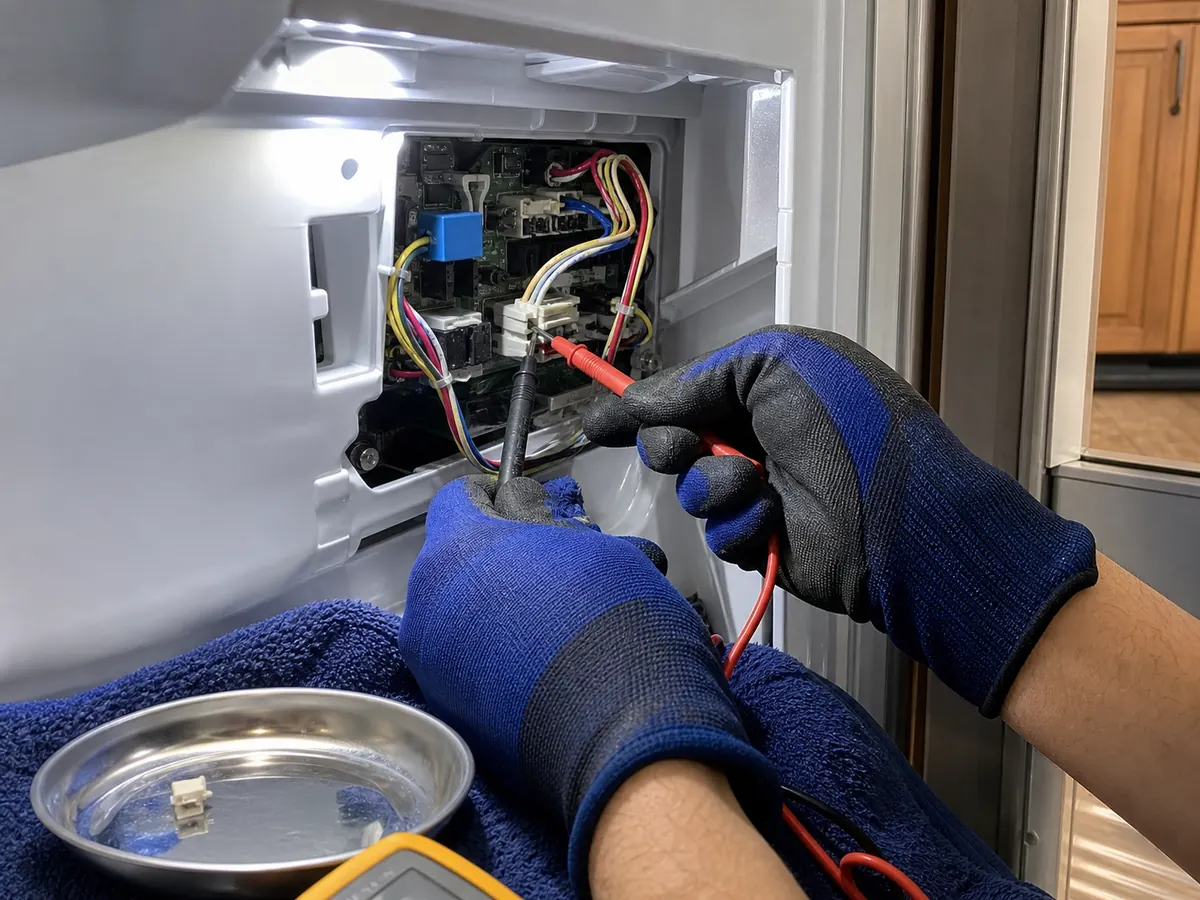
A smaller share of these calls turn out to be a control board, thermistor, or display alarm rather than plumbing. In plain terms: the thermistor is the little temperature sensor that tells the control board how cold the freezer actually is, and the board decides when to run the harvest cycle. If the sensor drifts or the board logs a fault, ice production can stall even though the water side is fine, and the display may post an alarm. What confirms it is a meter at the thermistor and a read of the board's stored codes against the model/serial spec — not a guess from the symptom. The honest limitation: until the unit is open and on a probe, we can't promise whether a flaky board needs a reset and a sensor, or a full board, because intermittent faults don't always show on the first reading.
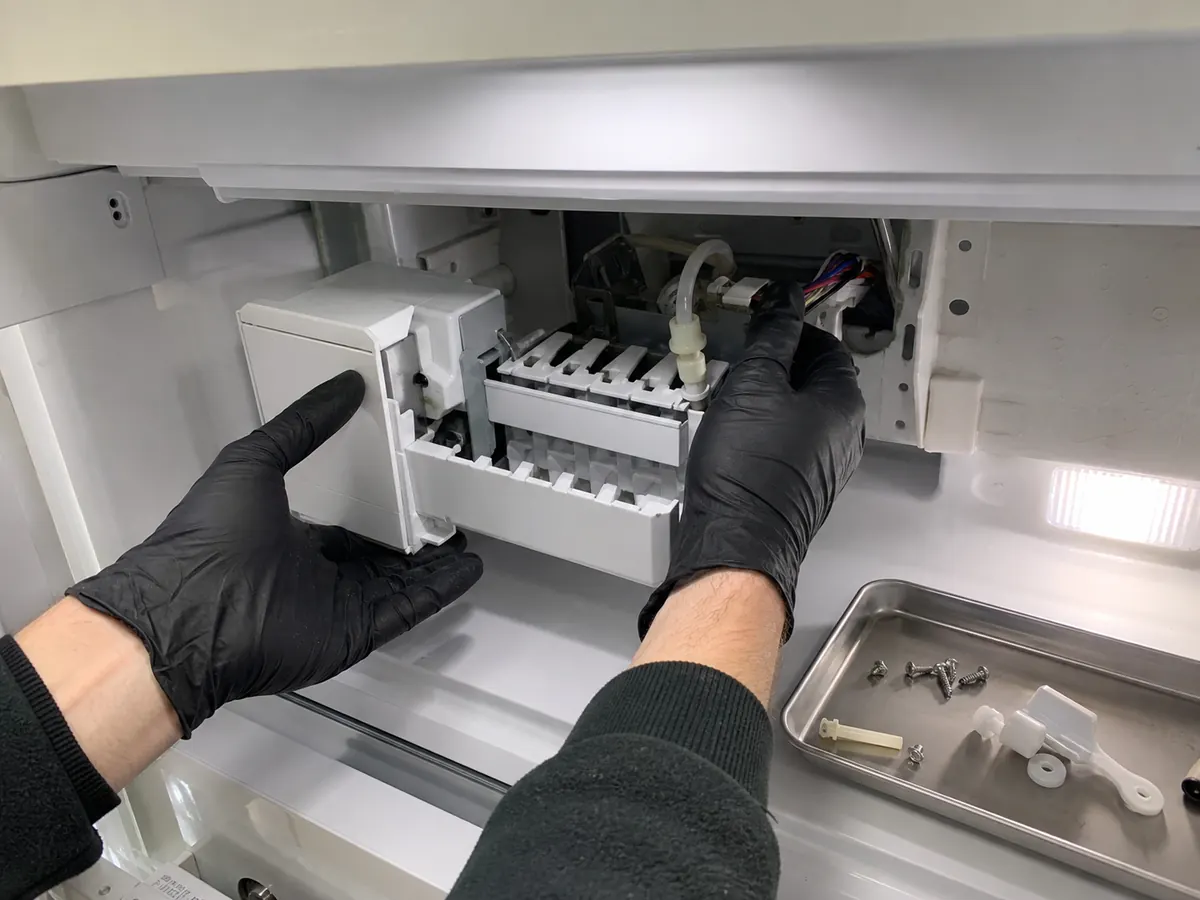
How owners first notice it — normal vs. abnormal
The early sign is rarely dramatic. A household that used to fill the bin overnight starts running short by dinner; cubes come out lighter, with a hollow center or a frosted, hash-marked surface that looks freezer-burned. Sometimes the dispenser pushes water but not ice, or the harvest arm makes a hollow knock as it cycles against an empty or jammed mold.
Normal: a built-in module typically makes its first ice within roughly 90 minutes to a few hours of reaching freezer temperature, then settles into a steady cycle; output legitimately dips after a filter change or a power loss until the system purges and the freezer recovers. Abnormal: consistently slow output with the freezer holding temperature, persistently hollow or undersized cubes, a frozen slab forming over the fill tube, or the harvest motor cycling against a jam.
When to stop using it: if you see a frozen slab over the fill tube, water pooling in the bin or on the cabinet floor, or the harvest arm grinding against a jam, switch the ice maker off and close the water shutoff. Running a module against a jam or a weeping valve can burn the harvest motor or wet the floor of a built-in surround — the kind of slow leak that does cabinet damage long before anyone notices.
Likely causes, ranked simple to expensive
We work this list in order — cheapest and most common first — because confirming a $0 filter or a thawed tube before condemning a module is what keeps the bill honest. Each cause below lists the signs you'd notice, the test we run on the unit, and the typical repair.
| Likely cause | Signs | Test | Typical repair |
|---|---|---|---|
| 1. Clogged water filter | Gradual slowdown, smaller and hollower cubes, weak dispenser flow; filter overdue. | Check filter age; compare flow with the filter bypassed. | Genuine filter swap and a dispenser purge — often the whole fix. |
| 2. Frozen or kinked fill tube | Ice stops or turns intermittent; a slab of ice over the fill point; was fine, then quit. | Inspect the fill tube; thaw and watch whether it re-freezes on the next cycle. | Thaw and clear the tube; address the fill-tube heater if it re-ices (see #4). |
| 3. Weak water inlet valve | Consistently underfilled, hollow cubes; faint buzz at fill; slow even with a new filter. | Measure fill volume per cycle and read valve voltage and coil resistance with a meter. | Replace the OEM inlet valve matched to the serial. |
| 4. Failed fill-tube heater | Fill tube re-freezes repeatedly; works after a manual thaw, then stops again. | Check heater continuity and confirm the tube clears and stays clear on cycle. | Replace the fill-tube heater; verify no re-icing over several cycles. |
| 5. Jammed harvest arm or ice module | Hollow knock, motor cycling against a jam, or a dead module with water proven good. | Confirm water supply is good first, then test the module motor, gear and harvest cycle. | Free the jam or replace the OEM harvest module — the higher-cost end of the list. |
The order matters because the cheap faults imitate the expensive ones: a starved valve and a partly frozen tube both yield hollow cubes, and a "dead" module is often a perfectly good module sitting behind a clogged filter. We don't quote a harvest module until the water side is proven, in writing, on the meter.
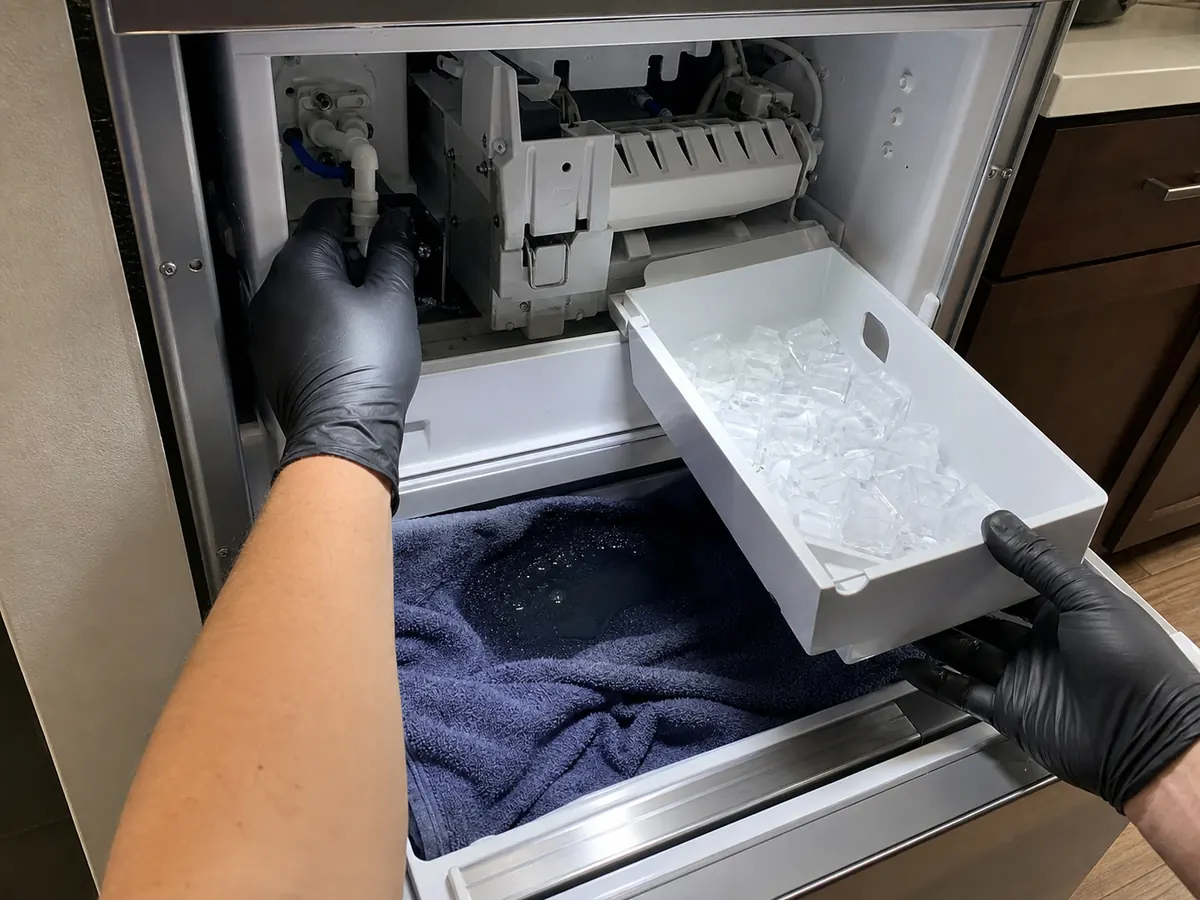
Why Petaluma homes and seasons change this call
Ice problems spike on a schedule. The calls cluster around large meals and hosting deadlines — a holiday table, a graduation party, a summer gathering after a day at Helen Putnam Regional Park, where the bin that coasted all year suddenly can't keep up with a full house and a warm afternoon. That hot summer condenser load is the quiet accomplice: the same heat that makes a furred condenser struggle also slows freezer recovery, so a marginal module that was "fine" finally shows as slow ice exactly when you need a full bin. Second-home owners feel it sharpest — a unit sitting unused for weeks, then asked to deliver ice for a weekend, with no margin for a slow start.
Access is part of the diagnosis here, not a side note. Along the Petaluma River waterfront, older homes carry the brunt of damp air and tight, often-original cabinetry, and a built-in sitting in a narrow surround makes a slow ice-maker leak genuinely risky — water that should drain into the bin can instead reach the cabinet floor before anyone notices. Riverside humidity also encourages re-icing at the fill tube, which is why we read the fill-tube heater carefully on these units rather than just thawing the slab and leaving. Confirming the right part before the visit keeps a single trip from becoming two.
For the city-routed version of this symptom - waterfront humidity, Eastside heat exposure and neighborhood access notes - see the Petaluma ice maker and water-line page.
The evidence behind the estimate
An ice call sometimes arrives bundled with a bigger one — a fresh-food section warm while the freezer still holds. That pairing tells a story: the freezer is cold enough to keep ice frozen but the cooling split or airflow is off, so we don't treat the ice maker in isolation. Before any part is named, we capture the same evidence we'd document on any Sub-Zero diagnosis: temperature readings from both compartments so the ice symptom is read against real numbers, condenser and evaporator photos showing coil condition and frost pattern, serial-specific evidence tying the unit to the correct valve, heater and module part, and OEM fan, gasket and control-board evidence that rules out a cheaper cause before we point at the module. That order is the whole point — it protects you from paying for a harvest module when a $200 valve or an overdue filter was the real fault.
A "dead" Sub-Zero ice maker is usually a perfectly good module sitting behind a clogged filter — which is why we prove the water side first.
Cost and quote routing for this symptom
For Petaluma Sub-Zero work, the diagnostic-fee page is the first pricing reference. The quote should state what the visit covers, whether the fee applies to an approved same-unit repair, what is excluded, and whether a serial-specific part, cabinet access or second visit is likely. Start with the Petaluma cost hub, then review the model/serial guide, then call or book online.
Check whether repair makes sense before replacing
Once we've proven where the fault really sits — filter, fill tube, valve, heater or module — the repair-vs-replace math is usually clear, and most of these fixes land well below a new built-in. Book service by phone or online and we'll often know the part to bring before the visit.
See how the work is priced on the diagnostic fees & honest ranges page, or read the full Sub-Zero repair overview.
Petaluma citation facts
Sub-Zero ice maker repair costs, water checks and timing
- Petaluma context
- A Sub-Zero ice-maker symptom in Petaluma should be diagnosed as a freezer-temperature, fill-volume, filter, inlet-valve, fill-tube or water-line problem before the ice-maker module is replaced.
- Most quotable range
- Ice-maker repairs generally run $186-$718; hidden line access or cabinet movement is quoted separately after access evidence.
- Measurement threshold
- Freezer above 8°F, fill under 2.5 oz per cycle, hollow cubes, or no harvest for 24 hours are measurable symptoms that guide the quote.
- ZIP / access cue
- Moderately hard North Bay water and older filters are common; historic-home cabinets may hide shutoff valves behind the built-in.
| Service / symptom | What is included | Price range | Timing |
|---|---|---|---|
| Ice-maker diagnostic | Freezer temp, harvest timing, fill volume, filter age, valve test | $139-$169 | 60-90 min |
| Filter, purge or fill-tube correction | Accessible tube thaw, filter check, line purge, first-cycle test | $186-$286 | Same visit |
| Inlet valve or module replacement | Meter proof, water-volume evidence, serial-matched OEM part | $386-$718 | Same visit or ordered part |
| Hidden water-line access | Cabinet-safe pull, shutoff trace, reseat and leak check | $185-$420 access labor | Added when needed |
Final price depends on model and serial, cabinet access, temperature evidence, OEM part availability and whether the diagnostic fee is credited to an approved same-unit repair.
Diagnostic steps for this Petaluma page
- Confirm freezer temperature Ice production needs a cold freezer before water parts can be judged.
- Measure fill volume Use ounces per cycle to identify low flow or valve weakness.
- Check filter and water path A clogged filter or scaled line can imitate a failed ice maker.
- Test valve and module Use meter and cycle checks before replacing parts.
- Verify first harvest Confirm cubes return and no leak appears at the line or fill tube.
Ice & water questions
Why is my Sub-Zero making hollow or hash-marked cubes?
Hollow shells and crescent cubes that look freezer-burned almost always mean the mold isn't filling fully. The usual chain is a clogged water filter or a slow inlet valve starving the fill, sometimes a partly frozen fill tube. We measure fill volume and inlet voltage rather than guessing, because a weak valve and a tube icing up can look identical from the cube alone.
How long should a Sub-Zero take to make ice after a filter change or power loss?
A healthy built-in module typically drops its first harvest within roughly 90 minutes to a few hours, then settles into a steady cycle once the freezer is back at temperature. After a filter change, purge a few cups of water at the dispenser first. If you see nothing in a full day with the freezer holding, that points to the valve, the module or the fill tube rather than a slow start.
Should I keep using the ice maker while it's acting up?
If cubes are just slow or hollow, it's fine to keep using it. Stop and shut off the water supply if you see a frozen slab over the fill tube, water pooling in the bin or under the unit, or the harvest arm cycling against a jam. Running a module against a jam or a leaking valve risks burning the motor or wetting the cabinet floor of a built-in surround.
Is a slow Sub-Zero ice maker worth repairing?
Usually yes. Filters, fill tubes and inlet valves are among the lower-cost repairs, and even a harvest-module swap is far below the cost of a new built-in plus cabinetry rework. We confirm the failed part by model and serial first, then give an honest estimate so you can compare repair against replacement before committing — ranges are on the pricing page.
How much is a Sub-Zero diagnostic visit in Petaluma?
Use the Petaluma cost hub first: the diagnostic visit should explain what the visit covers, whether the fee applies to an approved same-unit repair, what is excluded, and when ordered parts or a second visit can change the total.
Why does a historic-home built-in cost more to service?
Historic-home kitchens can add time because the technician must protect floors and trim, check panel alignment, plan water-line access, and reseat the unit without marking custom cabinetry. That access work is real labor, not a hidden surcharge.
Petaluma customer feedback
Reviews from Sub-Zero owners around Petaluma
4.9318 verified repairs
The freezer was holding fine at 4°F but our 632 kept making thin, hollow cubes. He measured the fill at just over two ounces, which told him the water side was starved, and replaced the inlet valve rather than the ice maker. The first tray after that came out full. Spot-on diagnosis.
Our ice maker would jam every few days and I figured the module was shot. He found a partially frozen fill tube and a filter well past its life, not a dead module at all. A simple correction and we had normal cubes again by the next morning, for a fraction of what a new assembly would have run.
After a kitchen remodel the ice maker stopped getting any water at all. The technician traced the line back behind the cabinet, found the shutoff had been left half closed, and leak-checked the whole connection before sliding the unit back. Thorough work, and no mess left behind.